


Warts on the penis are small formations that are located on the foreskin, frenulum, glans or on the shaft of the penis.They are also called genital warts.The pathology is provoked by the papillomavirus of certain strains, which are prone to recurrent manifestations and are never completely eliminated from the body.
Reasons for the formation of warts on the penis in men.

Warts are viral growths caused by the human papillomavirus.HPV is a large group of pathogenic microorganisms.There are around 100 studied strains of this pathogen.These viruses are also divided into different categories based on their level of oncogenicity.
According to rough estimates, about 90% of the world's population is infected with one or another type of papillomavirus.Pathogens live very little in the external environment and die quickly.It is most often transmitted through sexual contact, less frequently in everyday life or from mother to child.Viral agents are located in the superficial layer of the mucous membranes and epidermis.
As for warts on the penis in men, they are caused by strains 6 and 11. These viruses are responsible for the appearance of genital warts.These are conditionally non-oncogenic types, which in very rare cases can cause malignant neoplasms.
For the virus to enter the body, direct contact of infected skin or mucous membranes with healthy skin is necessary.This usually occurs during unprotected sex.The risk of infection increases if microtrauma occurs on the surface of the body: abrasions, cracks, scratches.The virus penetrates these lesions with special ease and speed.
HPV multiplies in the deep layers of the skin within human epidermal cells.As the disease progresses, epithelial cells ascend along with viral agents.This is how the papillomavirus reaches the surface of the skin and causes rapid chaotic growth of epidermal cells.This leads to the formation of warts on the penis.
A distinctive feature of the papillomavirus is that it can remain latent for a long time in the deep layers of the dermis.Several factors can cause its progress.For example, weakened immunity, hypothermia, taking antibiotics, stress, overwork, poor nutrition, vitamin deficiency, hormonal imbalance, etc.
However, even when the virus is in latent form, a person is potentially dangerous in terms of transmitting HPV to their partners.Knowing the causes of warts on the penis, we can conclude that these formations can appear both in adolescents who have recently started sexual activity and in older people.
Symptoms and types of warts on the penis.
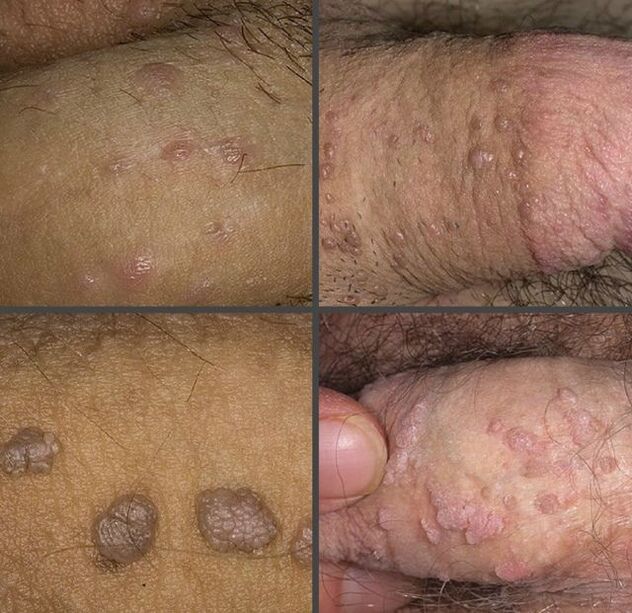
In most male patients, warts on the penis, as a rule, do not manifest themselves in any way.Most often they form in places prone to injury during sexual intercourse.Therefore, neoplasms can be found on the head, frenulum and foreskin.Less commonly, they appear on the shaft of the penis, scrotum, and testicles.
Warts on the penis usually look like small pinkish, beige and whitish growths, 2 to 30 mm in size.They can be alone or grouped, forming neoplasms similar to a rooster's comb.
In the active growth phase, when the immune system is not working properly, warts on the penis can cause itching and burning in the affected area.Also, sometimes neoplasms are noticed during sexual intercourse.Under normal conditions, these growths are painless and do not cause significant discomfort.
Often, condylomas do not affect a limited area of the genital organs, but rather large areas.Therefore, warts on the head of the penis often gradually spread throughout the groin area, affecting the anus area.
The types of warts on the penis depend on the strain of the virus that infects the man, as well as their location.
Let's see its main types:
- In the foreskin area, the neoplasms look like tubercles of a lighter tone than the skin.Sometimes they have a thin stem.Initially, single warts appear;Over time, clusters of condylomas can form.
- On the frenulum, warts look like small whitish nodules with a chaotic arrangement.
- Warts on the head of the penis look like pale pink finger-like projections.They tend to form groups similar to broccoli florets.
- Sometimes giant Buschke-Levenschein tumors can form in the shaft of the penis.They are several warts fused together.This is a rare but dangerous pathology that is fraught with malignant degeneration, since neoplastic cells are prone to rapid mutations.
If suspicious growths are found on the penis, the man should immediately contact a specialist.The urologist examines and interviews the patient.In addition to the penis, the urologist should examine the scrotum, perianal area, and groin.A visual examination is usually sufficient to make a diagnosis.In some cases, the doctor may refer the man for additional tests.
To identify the strain of the pathogen and the risk of oncogenicity, the patient must donate blood for a PCR test.Additionally, if the frenulum is affected, a meatoscopy procedure may be necessary to determine the presence of warts in the urethra.
It should be remembered that warts on the head of the penis and scrotum can resemble neoplasms of a different nature.For example, papulosis in the second stage of syphilis is also characterized by the appearance of small tumors.To exclude other sexually transmitted diseases, it is also necessary to be screened for common sexually transmitted infections: syphilis, HIV, chlamydia, trichomoniasis, etc.
The danger of warts on the penis in men.

Initially, warts on the penis are more of an aesthetic defect than a serious pathology that threatens a man's health.However, this does not mean that they do not need treatment.If the disease is left to chance, it can lead to more serious problems in the future.
The danger of these neoplasms is as follows:
- Development of phimosis.In this condition, the foreskin fuses with the head of the penis.Because of this, problems may arise with the normal discharge of sperm, pathogenic microorganisms accumulate in the space under the foreskin, and inflammatory processes may occur.
- Inflammation of the head and body of the penis.This pathology is a complication of the condition described above, when bacteria penetrate under the foreskin and spread further.
- The appearance of erosions on the genitals.Most often they develop as a result of systematic trauma to warts on the penis.This occurs during sexual intercourse, shaving, and wearing tight underwear.
- Degeneration of neoplasms into cancerous tumors.This occurs very rarely, but there is a potential danger, especially if the warts on the penis are damaged frequently.
Also, do not forget that active tumors are dangerous from the point of view of infecting a partner.Furthermore, even condoms cannot always protect a person from infection.
Treatment methods for warts on the penis.
Since the appearance of warts on the penis is directly related to a general decrease in immunity, the treatment of this pathology must be comprehensive and combined.Basically, various methods of destruction are used in relation to neoplasms.Medications are used to boost immunity and suppress the virus.
Methods to remove warts on the penis.
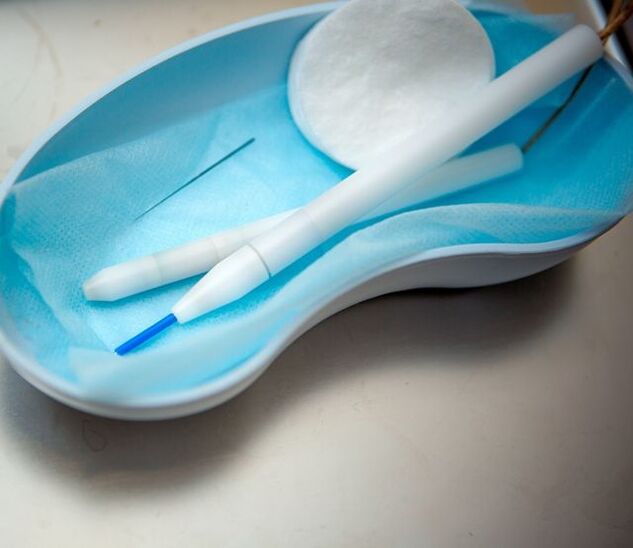
Instrumental and chemical methods are used to remove warts on the penis.It is worth remembering that these growths on their own rarely go away and will therefore need to be removed if a man seeks to minimize the risk of complications.
There are several ways to get rid of warts on the penis:
- Laser destruction.The laser beam evaporates the growth fluid, it dries, forms a scab, and falls off after a few days.As a rule, no traces remain at the treatment site.The procedure is painless and rarely causes relapses or complications.
- Cryorelimination.Liquid nitrogen, which has a low temperature, is applied punctually to the new growth and causes it to freeze and subsequently die.After treatment, a scab forms at the site of the growth, which also falls off after a few days along with the rest of the formation.
- Radiosurgical removal.The tumor is exposed to radio waves, which destroy the growing tissue.This is one of the most precise, effective and safest ways to remove penile warts.After the removal of radio waves, no traces remain on the skin.
- Electrocoagulation.At a certain frequency, a current is supplied to the electrode that destroys the formation.This procedure to remove penile warts can cause burns and, later, scars.Therefore, it is prescribed with caution.
- Surgical excision.If the wart on the penis is too large, in extreme cases the technique of cutting it with a scalpel can be used.But this operation is used very rarely, since there is a risk of serious bleeding and spread of infection.Additionally, complete circular excision of the foreskin is indicated in case of extensive wart damage.
Your doctor may also prescribe a chemical removal.The procedure is carried out using medical cauterizing agents.
Before treating warts on the penis with chemicals, it is imperative to consult a doctor, since these products have a number of contraindications and improper use can lead to complications.
Medicines for warts on the penis.
To eliminate the risk of reappearance of warts on the head of the penis or other parts of the genitals, it is necessary to take care of increasing immunity, as well as suppressing the virus in the body.For this, several groups of drugs are used: antivirals and immunomodulators.
Furthermore, with HPV it is important to stimulate the body's defenses, which for some reason are suppressed.The immune system will actively fight the pathogen and reduce the risk of penile warts reappearing.
It should be understood that drug therapy cannot completely solve the problem of warts on the penis.To get rid of them, it is necessary to resort to instrumental methods of removing growths.
Popular remedies against warts on the penis.

If you are thinking about how to treat warts on the penis, you can find help in traditional medicine.However, remember that you should resort to these methods only after consulting a doctor.Self-medication can be at least in vain and at worst lead to serious complications.
The following tools are popular:
- Tea tree oil.A powerful herbal antiviral agent that helps suppress pathogen activity.The substance should be rubbed on the warts on the head of the penis several times a day, every day until the growth is completely removed.
- Propolis.Another natural medicine that helps deal with viruses.To remove warts on the penis, apply the substance to the growths before going to bed every day for 10 to 14 days.
- Egg white.You need to take crude protein and lubricate the tumor with it several times a day.
- Table vinegar.Acid actively corrodes pathological tissues, and therefore care must be taken not to damage neighboring healthy areas.You must lubricate carefully and precisely.
- Rowan juice.The acidic substance contains phytoncides that have an antiviral effect.Warts on the penis should be lubricated every day with freshly squeezed liquid.
The above recipes are only suitable if you know for sure that it is HPV and the neoplasm is small and single.Otherwise, you cannot do without special therapy.
Prevention of warts on the penis.

Timely treatment of warts on the penis significantly reduces the risk of complications and relapses in the future.It is also a way to avoid transmitting the virus to a sexual partner.
One of the most effective prevention methods is vaccination with special multipurpose vaccines.They act against pathogens of types 6, 11, 16 and 18, precisely those that cause the appearance of genital warts.
Although condoms cannot guarantee 100% protection against HPV, they should be used as they reduce the risk of infection by 20 to 30%.It even protects against other sexually transmitted infections.
If a man is already infected with HPV, then it is necessary to follow the rules of a healthy lifestyle to reduce the risk of warts on the penis.It is important to quickly suppress exacerbations of chronic diseases, eat right, be physically active and keep the immune system in a "ready to fight" state.
If you are thinking about how to remove penile warts, consult a doctor immediately.Self-medication in this case can only cause harm.The procedure to remove tumors is quick and practically painless.In addition, it is important to strengthen the body's protective functions to avoid relapses in the future.